Singaporean favorite Stefanie Sun on Saturday was named best female artist at the 16th annual Golden Melody Awards, Taiwan's premier musical competition.
The victory marked the singer's comeback, achieved with "Stefanie," in the Chinese-language music competition which has a format similar to the U.S. Grammys.
In the best male artist category, Taiwan's Stanley Huang won for his metal-tinged rap rock album "Shades Of My Mind." Huang first gained fame in the hip-hop boy band the L.A. Boyz before striking out on his own.
His latest album was up for five awards.
Taiwanese singer Sandee Chan won best album of the year and best producer for "Then We All Wept in Silence."
Earlier, Taiwan's ethnic minority Hakka band Sheng Xiang/Water 3 won the prize for best rock group.
The victory was the third for the group. The win constituted a breakthrough for the band, which has been trying to gain a foothold in the top tier of the vibrant Taiwanese music scene.
Earlier, Sheng Xiang/Water 3 won in the best lyrics and best Hakka album categories.
The band's music describes the travails of farmers and workers using traditional instruments and singing in Hakka, a dialect spoken by an ethnic Chinese minority scattered throughout mainland China as well as Taiwan, Hong Kong, China and other parts of Asia.
Though its potential for commercial appeal might seem limited, Sheng Xiang/Water 3 had the highest number of nominations _ seven _ of any participant in Saturday's awards.
Hakkas, of ethnic Chinese origin, make up about 15 percent of Taiwan's population of 23 million. They are also well represented on the Chinese mainland.
In other key Golden Melody award, the Taiwanese aboriginal duo Power Station emerged victorious in the best vocal group category.
Aboriginals constitute less than 2 percent of Taiwan's population, but led by female pop icon A-mei, hold a prominent position in the island's musical culture.
The award for best new artist went to Taiwan's F.I.R., a rock trio with a female vocalist, for its debut album "F.I.R."
The Golden Melody Awards is distributing prizes in 33 categories, ranging from "best Taiwanese dialect vocal" to "album of the year."
The competition has a distinctly Asian accent, featuring three Chinese dialects and several aboriginal dialects from Taiwan.
6/01/2005


嗶-嗶,糾察隊來了
今天瀏覽了一下某入口網站的英語社群,看見了一個英語社群的名稱下寫了這麼一段文字:
這一段文字裡有明顯的錯誤,你知道是哪嗎?
該段文字實為一句格言,欲看正解請反白:
「Work like you don't need the money, love like you've never been hurt and dance like nobody's watching.」
Goolge "work like you don't need the money."
Work likes you don't need the money.
Love likes you've never been hurt.
Dance likes nobody's watching.
這一段文字裡有明顯的錯誤,你知道是哪嗎?
該段文字實為一句格言,欲看正解請反白:
「Work like you don't need the money, love like you've never been hurt and dance like nobody's watching.」
Goolge "work like you don't need the money."
5/31/2005
網站介紹:Grammar and Writing / 常見的文法問題 / people VS persons


我真的忘記我怎麼來到這個網站的,也真的忘記我為何逛到Frequently Asked Questions,我無意間看到『people vs persons』,這個疑問躲在我腦中有一段時日了,不是說person的複數就是people,為何又有persons呢? 兩者該如何運用呢?
網站裡有許多英文文法和寫作的知識,而在Frequently Asked Questions這一區裡,解答了許多人常有的英文問題。
affect versus effect
accept versus except
bad versus badly
bring versus take
compare to versus compare with
different from versus different than
do versus make
due to versus because
if versus whether
into versus in to
its versus it's
i.e. versus e.g.
less versus fewer
lie versus lay
people versus persons
shall versus will
that versus which
toward versus towards
well versus good
.
.
.
.
.
Update:
BBC Learning English/Ask About English: Person and people
So in summary, normally you find 'people' as the plural form of 'person' – one person, three people. Sometimes you'll find people used to describe the nationality so you'll find 'peoples' to describe different nationalities and sometimes you'll find the word 'persons' in more formal styles of writing or in signs for example.
Word of mouth
口耳相傳
"word of mouth"
Something that you heard from other people you know by word of mouth.
Example: "How did you hear about this party?"
Reply: "Word of mouth."
When you say that you heard something word of mouth, you are not being specific about whose mouth you heard it from; just that you heard it from another person.
Example: "There has been talk at school about canceling the concert." Reply: "Really? Who did you hear that from?" Answer: "Just word of mouth."
We do rely on what other people tell us, so word of mouth is one important way that we learn things. If something is "only" (or "just") word of mouth then you might not know where the "word" really started or how it changed as it went from "mouth" to "mouth".
Example: "Did you hear they finally arrested that guy?"
Reply: "Yes, but that's only word of mouth."
Example: "Where did you hear that?"
Reply: "Just word of mouth."
explanation and example sentences from English, Baby!:
Sometimes, you hear about a movie through word of mouth.
word of mouth (expression)
Example: I found out through word of mouth that my boyfriend has another girlfriend.
"word of mouth"
Something that you heard from other people you know by word of mouth.
Example: "How did you hear about this party?"
Reply: "Word of mouth."
When you say that you heard something word of mouth, you are not being specific about whose mouth you heard it from; just that you heard it from another person.
Example: "There has been talk at school about canceling the concert." Reply: "Really? Who did you hear that from?" Answer: "Just word of mouth."
We do rely on what other people tell us, so word of mouth is one important way that we learn things. If something is "only" (or "just") word of mouth then you might not know where the "word" really started or how it changed as it went from "mouth" to "mouth".
Example: "Did you hear they finally arrested that guy?"
Reply: "Yes, but that's only word of mouth."
Example: "Where did you hear that?"
Reply: "Just word of mouth."
explanation and example sentences from English, Baby!:
Sometimes, you hear about a movie through word of mouth.
word of mouth (expression)
- something you hear from someone else
Example: I found out through word of mouth that my boyfriend has another girlfriend.
5/30/2005
短篇英文作文120篇
適合國三英語高材生及高中生,熟背後,可應用於各類型的聯考。
http://www.hgjh.hlc.edu.tw/assist1/assist/spc/culver/short1-40.htm

For more samples of short essays, you can check out the website at
http://www.hgjh.hlc.edu.tw/assist1/assist/spc/culver/eng.htm
http://www.hgjh.hlc.edu.tw/assist1/assist/spc/culver/short1-40.htm
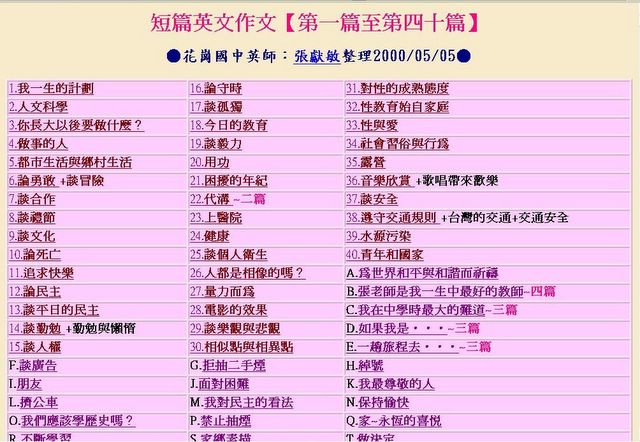
For more samples of short essays, you can check out the website at
http://www.hgjh.hlc.edu.tw/assist1/assist/spc/culver/eng.htm
5/29/2005
學習英語的五十種策略
學習英語的五十種策略
英語教學 研究報告
資料來源: Teaching by Principles, by H. Douglas Brown, pp.221-223
學習英語的五十種策略 資料收集/翻譯者:陳慧文
Part A
1. I think of relationships between what I already know and new things I learn in English.
思考新學的與已學過的英文有何關聯.
2. I use new English words in a sentence so I can remember them.
用新學單字造句以便牢記生字.
3. I connect the sound of a new English word and an image or picture of the word to help me remember the word.
記生字時,將字的發音與其圖像做連結.
4. I remember a new English word by making a mental picture of a situation in which the word might be used.
記生字時,在腦中想像一個此字可以被運用的情境.
5. I use rhymes to remember new English words.
使用詩歌韻文記憶生字.
6. I use flashcards to remember new English words.
使用有圖有字的閃卡記憶生字.
7. I physically act out new English words.
以肢體表演所學的生字.
8. I review English lessons often.
經常複習課文.
9. I remember new English words or phrases by remembering their location on the page, on the board, or on a street sign.
記生字或片語時, 會去記這些生字或片語, 出現在那一頁、那一個刊版、或那一個街道的標示上.
Part B
10. I say or write new English words several times.
學生字時,多說或多寫幾次.
11. I try to talk like native English speakers.
試著說道地的英語.
12. I practice the sounds of English.
練習英語發音.
13. I use the English words I know in different ways.
以不同方式使用所知的英文單字.
14. I start conversations in English.
主動使用英語與人交談.
15. I watch English language TV shows spoken in English or go to movies spoken in English.
觀看英語發音的英語電視節目或電影.
16. I read for pleasure in English.
以閱讀英文為樂.
17. I write notes, messages, letters, or reports in English.
使用英文留紙條、留話、寫信、或寫報告.
18. I first skim an English passage (read over the passage quickly), then go back and read carefully.
先快速瀏覽一段英文,然後再重新細讀它.
19. I look for words in my own language that are similar to new words in English.
在母語裡,找英文生字的同義字詞.
20. I try to find patterns in English.
試著找出英文的規則.
21. I find the meaning of an English word by dividing it into parts that I understand.
將一個生字,拆成一些我所知道的部份,來了解其含義.
22. I try not to translate word-for-word.
嘗試不逐字翻譯.
23. I make summaries of information that I hear or read in English.
將所聽所讀的資訊,以英文做摘要.
Part C
24. To understand unfamiliar English words, I make guesses.
對不熟悉的英文單字,去猜它的意思.
25. When I can’t think of a word during a conversation in English, I use gestures.
與人英語對話,有一個字忘了怎麼說時,以動作來表達.
26. I make up new words if I do not know the right ones in English.
不知道正確的英文單字時,會自己編造.
27. I read English without looking up every new word.
讀英文時,不會每逢生字便查字典.
28. I try to guess what the other person will say next in English.
嘗試猜猜別人接下來要說的英文是什麼.
29. If I can't think of an English word, I use a word or phrase that means the same thing.
想不起一個英文單字時,以一個同義字或同義詞替代.
Part D
30. I try to find as many ways as I can to use my English.
想辦法以各種方式來使用所學到的英文.
31. I notice my English mistakes and use that information to help me do better.
知道自己所犯的英文錯誤,並能善用它來幫助自己學得更好.
32. I pay attention when someone is speaking English.
每當有人說英語時, 注意聽.
33. I try to find out how to be a better learner of English.
想辦法找出把英文學得更好的方法.
34. I plan my schedule so I will have enough time to study English.
做好規劃,找出足夠的時間學英文.
35. I look for people I can talk to in English.
找尋可以英語會話的對象.
36. I look for opportunities to read as much as possible in English.
找尋機會盡可能讀英文.
37. I have clear goals for improving my English skills.
確立明確目標,不斷增進英文聽說讀寫能力.
38. I think about my progress in learning English.
思考自己英文學習的進展.
Part E
39. I try to relax whenever I feel afraid of using English.
每當覺得害怕使用英文時,想辦法放鬆自己.
40. I encourage myself to speak English even when I am afraid of making a mistake.
甚至當害怕會犯錯時,仍鼓勵自己說英語.
41. I give myself a reward or treat when I do well in English.
當自己的英文表現不錯時,給自己獎賞或好好吃一頓.
42. I notice if I am tense or nervous when I am studying or using English.
注意自己學習或使用英文時會不會緊張.
43. I write down my feelings in a language learning diary.
寫日記,記錄學習英文的感想.
44. I talk to someone else about how I feel when I am learning English.
與別人分享學英文的感想.
Part F
45. If I do not understand something in English, I ask the other person to slow down or say it again.
聽不懂英文時,請他人放慢速度或再說一次.
46. I ask English speakers to correct me when I talk.
說英語時,請英語為母語人士幫你更正錯誤.
47. I practice English with other students.
與同學一起練習說英語.
48. I ask for help from English speakers.
求助於英語為母語人士.
49. I ask questions in English.
用英語發問.
50. I try to learn about the culture of English speakers.
嘗試學習了解英語文化.
Reference: http://140.128.223.1/2003Web/index.htm, 專業成長
5/27/2005
(1) Idiom: at loose ends (2) 看娛樂新聞學英文
at loose ends-美式用法
at a loose end-英式用法
Reference:
M-W's Learner's Word of the Day (5/25)
成語常用翻譯辭典/鄭光立
Merriam-Webster Online有每日一字可訂閱,那些單字都過於艱澀,連以英語為母語的人士都覺得招架不住,遑論我們這些學英文的人。
基於這個原因,他們設了一個Learners Word of the day,歡迎學習者踴躍訂閱,每日將會收到一封『每日一字』。
看娛樂新聞學英語
Taiwanese singer Vivian Hsu makes comeback with new image
Love Unreservedly 狠狠愛
Eyes That Love to Laugh 愛笑的眼睛
(以上兩首我兩歲半的niece很會唱呢! )
at a loose end-英式用法
Meaning:
not knowing what to do ; not having anything in particular to do
中譯: 沒有事做、沒什麼事
Examples:
I have been at loose ends since I graduated from school.
我畢業後就沒事做。
Drop by if you find yourself at loose ends this weekend.
若你週末沒什麼事的話就來看看我吧。
Reference:
M-W's Learner's Word of the Day (5/25)
成語常用翻譯辭典/鄭光立

Merriam-Webster Online有每日一字可訂閱,那些單字都過於艱澀,連以英語為母語的人士都覺得招架不住,遑論我們這些學英文的人。
"It is far too advanced for beginning ESL students and is challenging for even native speakers of English. I'm glad to see that now they are providing this new service that is better suited to the needs of ESL learners. "
基於這個原因,他們設了一個Learners Word of the day,歡迎學習者踴躍訂閱,每日將會收到一封『每日一字』。
看娛樂新聞學英語
Taiwanese singer Vivian Hsu makes comeback with new image
Love Unreservedly 狠狠愛
(1) reserved:保留的。
(2)『 un 』表否定,unreserved:沒有保留的。
(3) 必須以『副詞』來修飾動詞,
故『 unreserved 』→ 『 unreservedly 』。
(4)『-ly 』是普遍的副詞形式。
Eyes That Love to Laugh 愛笑的眼睛
(以上兩首我兩歲半的niece很會唱呢!
)
訂閱:
文章 (Atom)